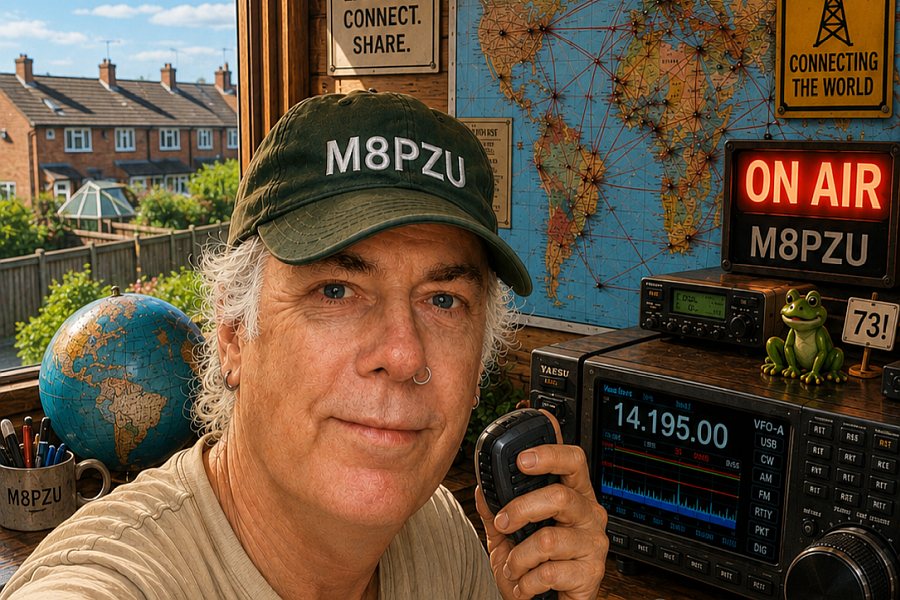
After passing my first Foundation exam, I decided almost immediately that I wasn’t going to stop there. Since I had already started, I wanted to work my way through the entire UK licensing system and eventually reach Full. I booked my Intermediate exam on the very same day that I passed Foundation, setting the date three weeks ahead. At the time, I had no idea whether that was a lot of time or very little. In the end, with about an hour of study each day, three weeks turned out to be more than enough.
I didn’t take any formal course. My main method was doing mock exams. I worked through one set of questions after another, and whenever I didn’t know an answer, or felt that I was guessing rather than actually understanding it, I stopped and tried to work out why the correct answer was what it was.
ChatGPT helped me a lot with this. I could paste in a question, ask for a simple explanation, and if I still didn’t understand something, ask for a different approach or an example. What mattered to me was understanding the principle behind the answer. That way, even if a question in the real exam was worded differently, I would still know how to work it out.
At the beginning, my mock exam scores were around 30 correct answers out of 46. Later, I was regularly getting 40 or 41. By then, I knew I had a comfortable margin and it became more about maintaining a good standard than simply being able to pass the exam. Ambition. 😉
The part of electronics I struggled with most was resonant circuits. I already knew something about resistors, capacitors and semiconductors, but inductors were much less familiar to me. I particularly found questions difficult when I had to understand how a whole section of a circuit worked rather than simply put some numbers into a formula.
Then there were decibels, RF calculations, filters, mixers, transmitters and receivers. Sometimes the difficult part wasn’t even the subject itself, but understanding exactly what the question was asking.
There were also things that couldn’t really be worked out logically. Some details of the regulations simply had to be memorised. I found subjects that I could relate to practical experience much easier.
After passing Foundation, I had started operating normally on HF, so antennas, SWR, feeders, propagation, safety and radio operation were no longer just theory from a textbook. I could see at my own station what high SWR meant, how an antenna behaved on different frequencies and how propagation conditions changed. I also already knew some of these subjects from my CB radio days.
For practice, I mainly used the GM6DX mock exams and UK Ham Quiz. By the end of my preparation, my results were stable enough that I wasn’t particularly worried about whether I would pass. I just had to get the actual exam done.
In the end, I scored 43 correct answers out of 46.
After only three weeks of studying, I was really pleased with that result. Especially as I hadn’t spent entire days buried in books. Most of the time it was around an hour a day, occasionally a little longer if I came across a subject that needed more work.
The important thing was that the second level was now behind me. So, once again, I booked the next exam on the very same day, this time the Full licence exam three weeks later, and started looking through the study material.
That was when I saw the real jump in difficulty.
Converters, stubs, return loss, filter characteristics and a whole range of more advanced topics quickly made me realise that the difference between Intermediate and Full was much greater than the difference between Foundation and Intermediate. But having already said A and B, I might as well say C as well.
After the exam, there was still the administrative side to deal with. I had to wait a few days for the result to appear in the Ofcom system. Interestingly, my paper certificate actually arrived before I was able to obtain my new licence and choose a new callsign.
On Saturday morning, I checked my account yet again, without much hope because it was already the weekend. And suddenly, the option to obtain the licence was there.
I chose the callsign M8PZU, keeping the PZU suffix from my previous M7PZU. Of course, that was followed by changing my callsign on QRZ, HamQTH, in my logs and on various other services, but that is another story.
Ahead of me were another three weeks of studying, this time for the final exam.