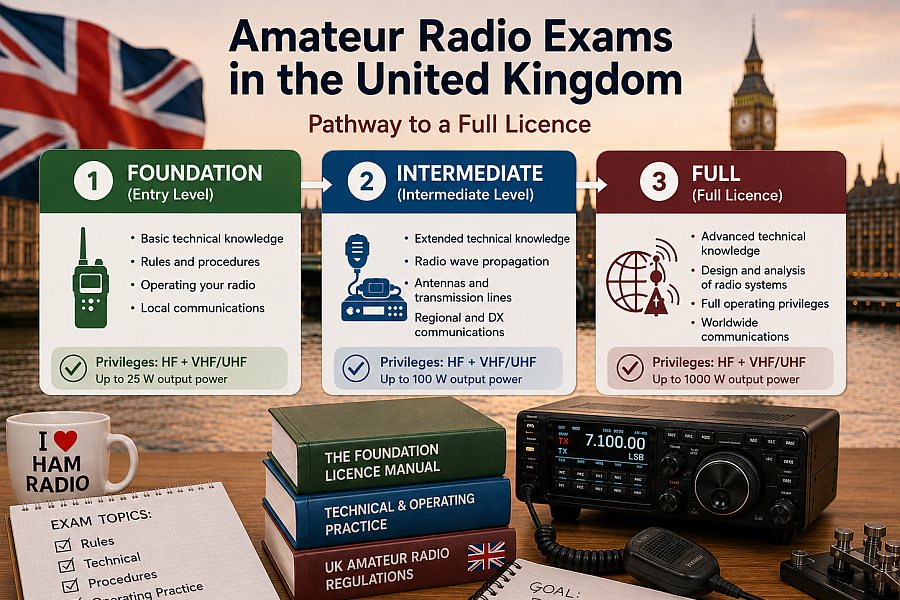
You may be wondering what becoming a radio amateur in the UK involves, which exams you need to pass and what privileges you receive at each stage. Or perhaps you already live in the UK and are thinking about getting your licence.
The UK amateur radio licensing system is based on three successive levels: Foundation, Intermediate and Full. I completed the whole path myself within just a few weeks, so I can also describe it from personal experience.
It is worth starting by explaining the role of two organisations that are easy to confuse. The RSGB, the Radio Society of Great Britain, is responsible for things such as the examination system, training materials and organising exams. Ofcom, on the other hand, is the UK communications regulator. It is Ofcom that issues amateur radio licences and allocates callsigns. It is Ofcom that issues the licence and allocates your callsign.
One major advantage of the British system is that the entire exam can be taken from home. You book a date, pay the exam fee and, at the agreed time, connect online with the invigilator.
The first level is Foundation. The exam contains 26 questions, and you need at least 19 correct answers to pass. You have one hour. The syllabus mainly covers the basics of radio operation, regulations, safety, antennas, propagation and basic technical subjects.
In my opinion, this is an exam that is accessible to almost anyone. If you spend some time studying and complete enough mock exams, you should not have too much difficulty with it.
After passing Foundation, you receive a proper M7xxx callsign and can start operating on the amateur bands. The number 7 identifies a Foundation licence. The current maximum power is 25 W PEP on bands where the licence conditions permit it.
The next level is Intermediate. This is where things become much more interesting. The exam contains 46 questions, and currently you need 28 correct answers to pass. You have 90 minutes. There is considerably more electronics involved. You need to understand resonance, filters, power supplies, transistors, antenna matching, propagation, installation safety and many other subjects.
For me, Intermediate was the biggest step up. Foundation can largely be treated as an introduction to amateur radio. At Intermediate level, you really start to understand what is happening inside the radio and why certain things work the way they do.
After passing this level, you can use up to 100 W PEP where permitted by the licence. Your callsign also changes to M8xxx, as the number 8 identifies an Intermediate licence.
The final stage is Full. The exam consists of 58 questions and lasts two hours. The current pass mark is 35 correct answers. At this level, there is a great deal of electronics and you have to go into much more depth. The syllabus includes more advanced circuits, amplifiers, modulation, electromagnetic compatibility, antennas, calculations, semiconductors, transmitters and receivers.
I prepared for this exam more intensively than for the others. I used mock exams, YouTube videos and the official bank of around 570 Full exam questions released by the RSGB in 2026.
ChatGPT also helped me a great deal. Whenever I didn’t understand something, instead of trying to memorise the answer, I asked for the subject to be explained in simpler language. Sometimes I needed to approach the same problem from two or three different angles before everything finally clicked.
In the end, I passed the Full exam as well and received the callsign G5LSB. A Full licence naturally gives you the widest range of privileges. Current UK regulations allow operation at up to 1,000 W PEP on bands where the amateur service has the appropriate primary allocation. That does not, of course, mean that 1,000 W is automatically permitted on every band. You always need to check the licence conditions for the particular frequency range.
My path therefore looked like this:
| Licence | Questions | Pass mark | My difficulty rating |
|---|---|---|---|
| Foundation | 26 | 19 | ⭐⭐⭐☆☆☆☆☆☆☆ |
| Intermediate | 46 | 28 | ⭐⭐⭐⭐⭐⭐☆☆☆☆ |
| Full | 58 | 35 | ⭐⭐⭐⭐⭐⭐⭐⭐⭐☆ |
Interestingly, there is now also the option of taking the Direct to Full exam without first completing Foundation and Intermediate. It is, however, a separate and considerably larger exam, and in my opinion, for someone starting from scratch, the traditional route through all three levels makes a lot of sense.
I completed all three levels one after another, with three-week gaps between them. It was intensive, but it also meant that the knowledge from the previous level was still fresh when I started preparing for the next one.
If you live in the UK and are thinking about amateur radio, there is little reason to keep putting off Foundation. You can get started relatively quickly, get on the air, gain practical experience and then decide whether you want to continue further. A Full licence also allows you to operate in many countries around the world under CEPT arrangements.
73