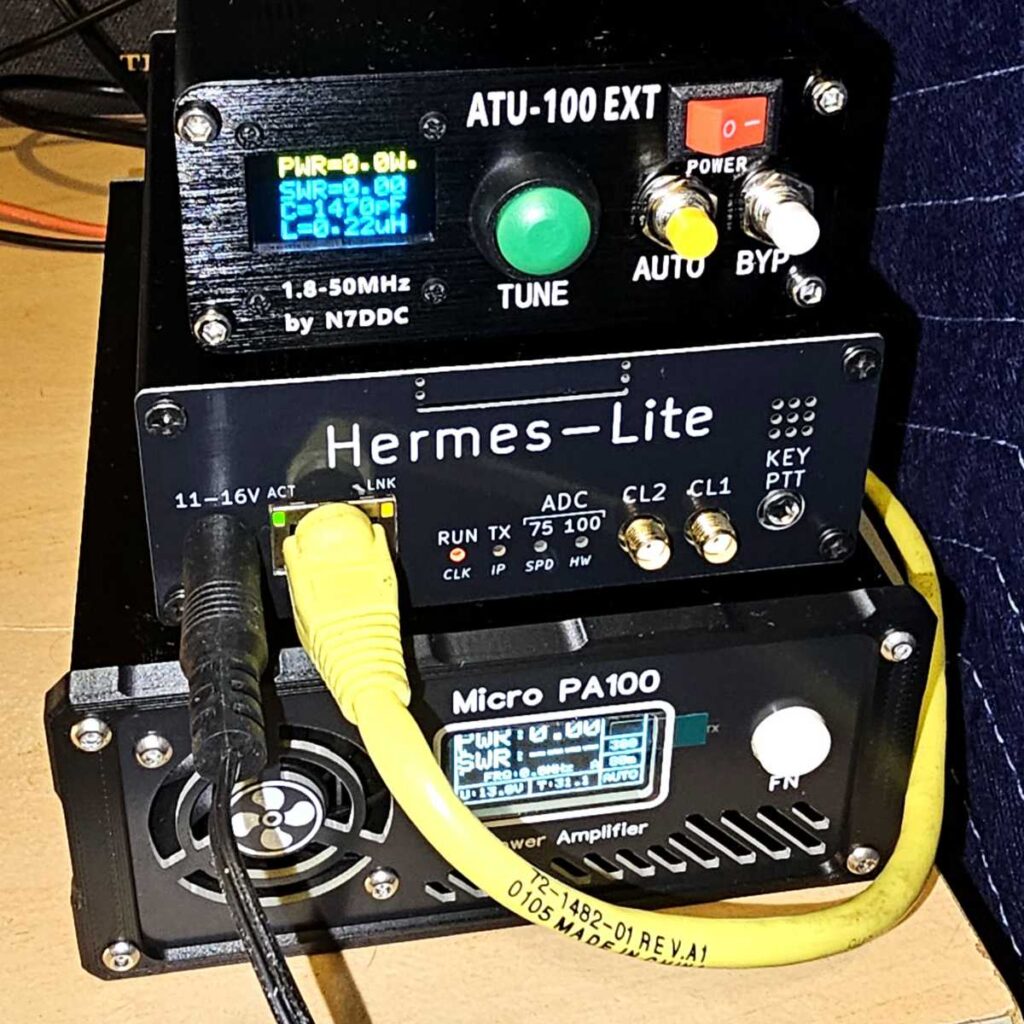
If you want to read how I started my remote station project based on Hermes Lite 2, you can find the first post here. At that stage, I had finished setting up the Hermes, configuring Thetis and WSJT-X, and carrying out the first FT8 tests. Just one watt was enough to make a QSO with Switzerland at a distance of around 1,000 kilometres, while PSK Reporter showed my signal being received across many parts of Europe and even on the other side of the Atlantic.
The natural next step was to increase the power. Five watts from the Hermes is excellent for QRP experiments and FT8, but for normal SSB operation I wanted to be able to use around 50 to 100 watts. So I ordered a Micro PA100 amplifier and an ATU100 automatic antenna tuner. The tuner arrived after about a week, while the amplifier decided to take a much longer journey through several logistics hubs and finally arrived more than two weeks later.
I carried out the first PA100 tests into a dummy load. The Hermes turned out to be a very convenient source of drive because the output power can be adjusted smoothly in Thetis. At maximum drive, the amplifier produced a little over 100 watts. For everyday use, however, I decided to run it at around 60 to 70 watts. That gives me practically all the advantages of a normal 100-watt station while leaving some headroom and putting less stress on the output stage.
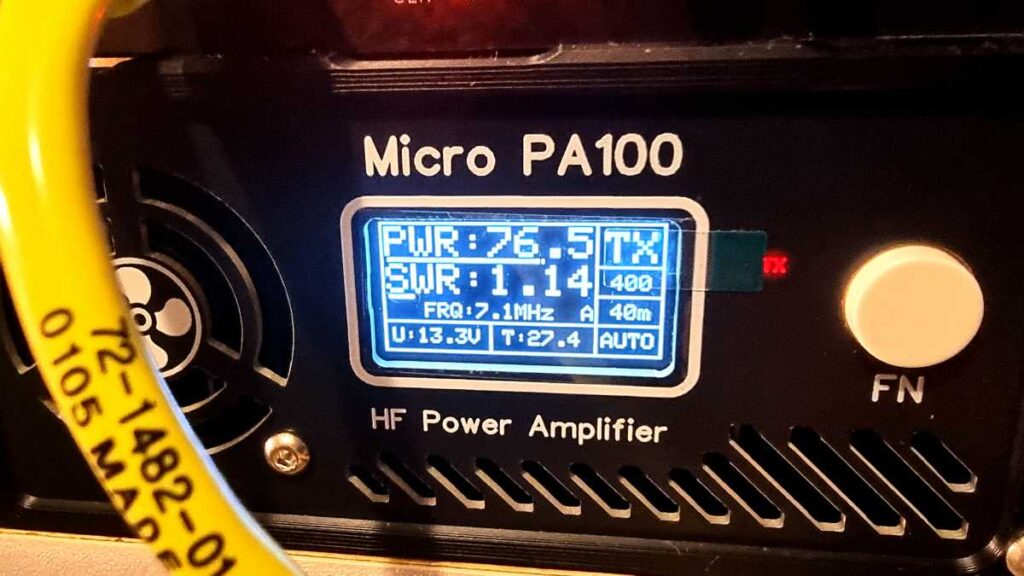
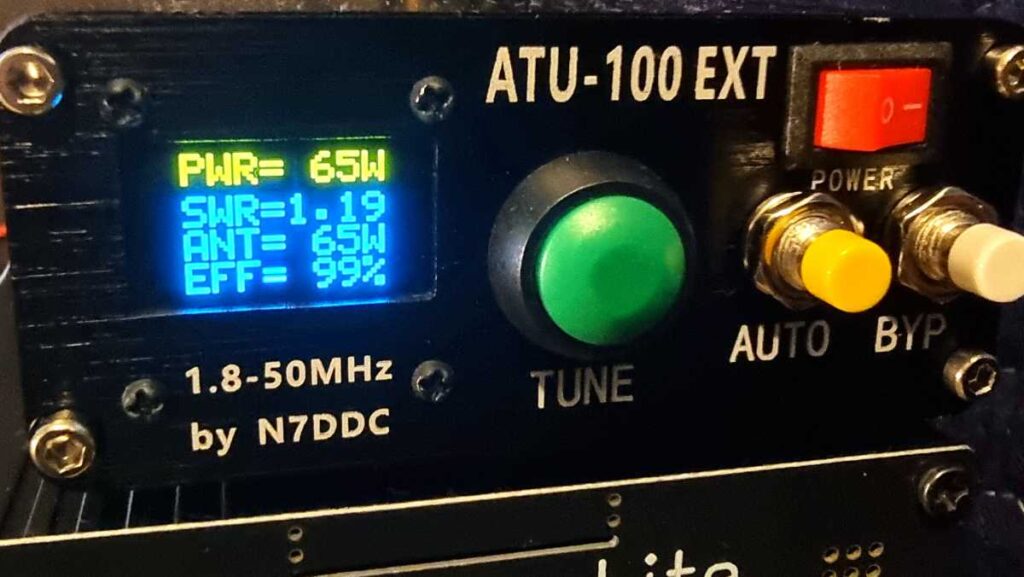
One interesting part of the setup was adjusting the power used for antenna tuning. The ATU100 should not switch its relays at full power, so I configured a separate output level for the TUN function in Thetis. After a few attempts, I found a setting that gives the tuner around 8 to 15 watts on most bands. That is enough to start the tuning process reliably while remaining safe for the relays.
The ATU100 itself also surprised me positively. On 20 metres, for example, my antenna showed an SWR of around 3:1. After tuning, the ATU displayed about 1.2:1, and the amplifier then saw an almost perfect match.
On 80 metres, however, I ran into an interesting problem. The PA100 detected the high SWR faster than the tuner could complete its tuning cycle, so the amplifier activated its protection and switched into bypass. The solution was to tune the antenna first using the Hermes alone, and only then switch the amplifier back on. That was a useful lesson, especially for future remote operation.
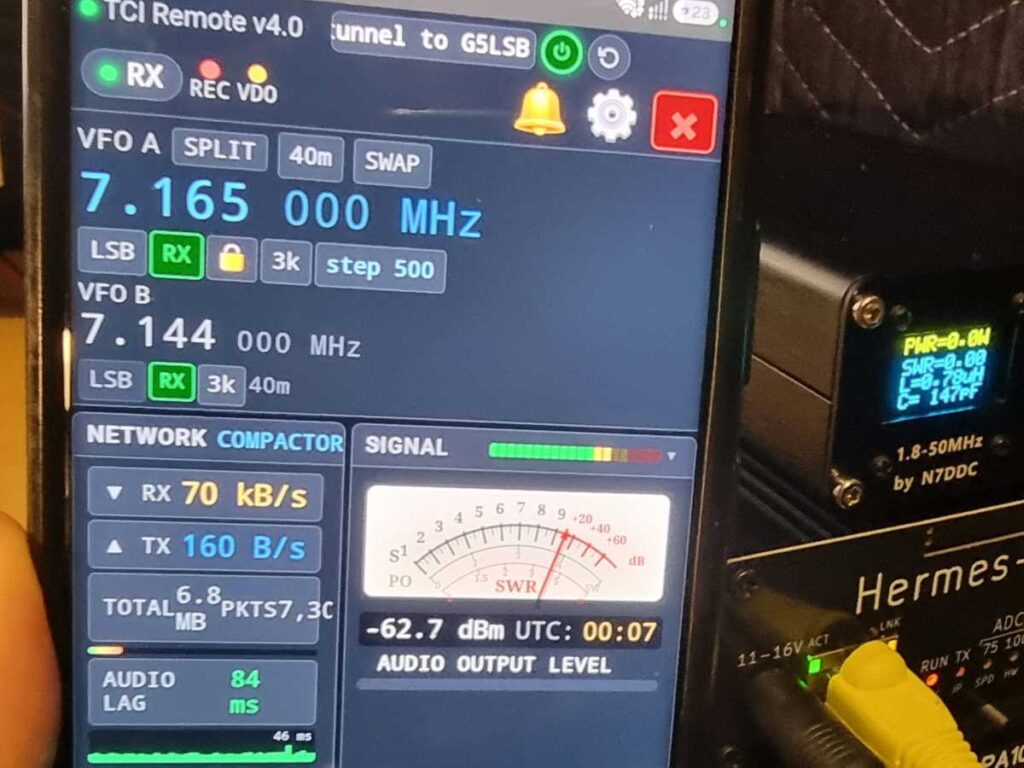
The most important test, however, was operating through the phone. I bought the full version of TCI Remote Compactor and connected to the station using TCI Remote on Android. The phone shows the waterfall, allows me to change frequency and mode, control PTT, listen to the receiver and transmit using the phone’s microphone.
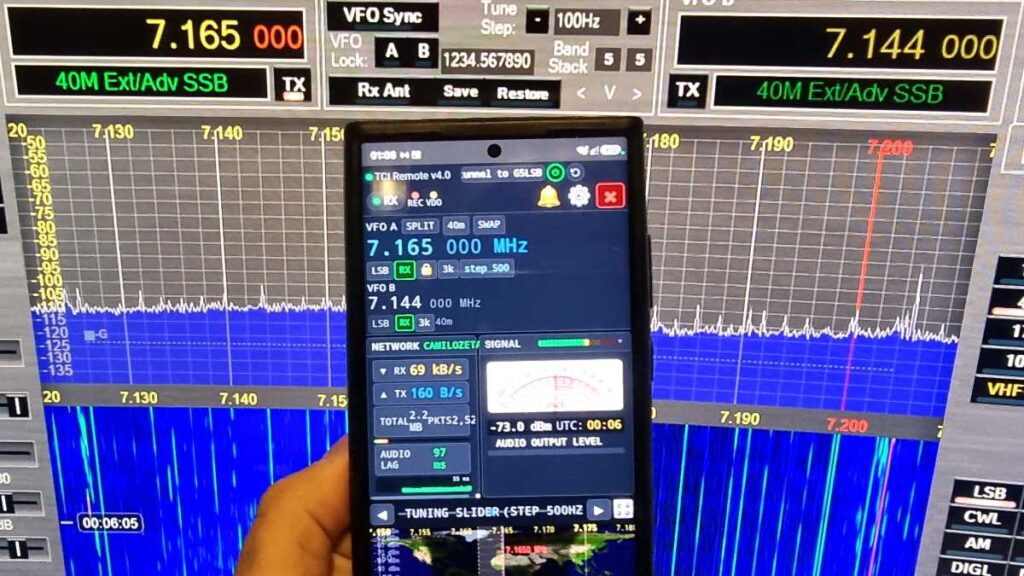
My first proper QSO through the phone resulted in a 5/8 report. Later, I made further contacts with stations in Germany and France, receiving 5/9 reports and very positive comments about the audio quality.
At first, the phone microphone was using automatic AGC, which was increasing the gain to values as high as 150. After switching to manual control at around 80, the modulation became much more predictable and natural.
I also had an unexpected chance to test the PA100 protection system. On one occasion, I forgot to switch the antenna before transmitting. The amplifier immediately detected a very high SWR, started sounding an alarm and disabled amplification. Nothing was damaged, but it was reassuring to see that the protection actually works.
There was really only one small issue left. By default, the PA100 detects incoming RF and only then switches into transmit mode. With SSB, this means that the beginning of the first syllable can be transmitted at the low output power of the Hermes before the amplifier has time to switch on.
To solve this, I decided to use the EXTTR output on the Hermes Lite 2 and control the amplifier PTT directly through its ACC socket. This way, the PA will switch into transmit mode as soon as I press PTT, before the SSB signal itself appears.
After several weeks of assembling, configuring and testing, I now have a fully working remote HF station based on Hermes Lite 2, Thetis, TCI Remote, PA100 and ATU100.
From my phone, I can listen to the bands, tune the radio, watch the waterfall and make normal QSOs with up to around 100 watts of output power.