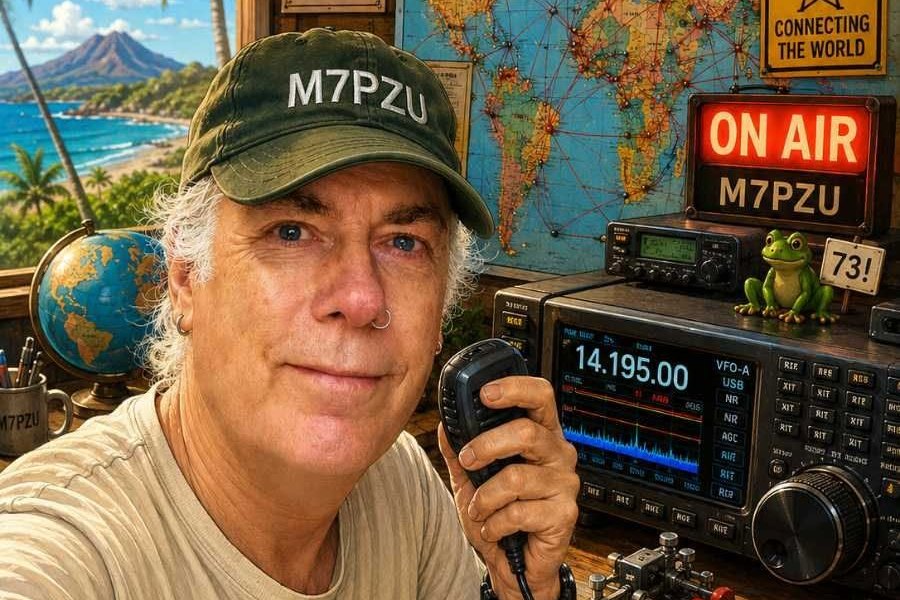
My name is Dave. I’m Polish, although I now live in Birmingham in the UK, and I’d like to tell you the story of how I became an amateur radio operator. I grew up in Poland, and my adventure with radio began there when I was about 10 or 11 years old. Quite by accident, I wandered into an amateur radio club at a local community centre. I saw people sitting at a radio station and talking to people all over the world. I only went in out of curiosity, but I stayed for a good half an hour. I watched how everything worked and I have to admit, it made a huge impression on me.
For years afterwards, the idea stayed somewhere in the back of my mind. I even had my own handheld radio, a Polish Trop radiotelephone from the communist era, which many of you probably won’t remember. It was my first opportunity to talk to someone without any wires, using nothing but an antenna and radio waves. Another small step that pulled me further into the world of radio.
Then came the early 1990s and the huge CB radio craze. Everyone seemed to be talking about it, so I decided to give it a try as well. I bought my first CB radio and put a half-wave antenna on the roof. It was fantastic. At last, I could pick up a microphone and start making contacts.
Of course, at first I was incredibly nervous. I was almost afraid to speak. When I finally made my first contact, I could feel my face turning red. Over time, though, I gained experience, everything became more natural, and conversations on CB could sometimes be genuinely interesting.
Every now and then, the idea of getting a licence and becoming a proper amateur radio operator came back to me. At the time, though, it seemed quite difficult. You had to learn Morse code, regulations and all sorts of technical subjects. So I kept putting it off from one year to the next, or rather, from one decade to the next.
Then, finally, 2026 arrived. I thought that since I was already past fifty, perhaps it was time to fulfil that childhood dream at last. I started studying and booked my exam.
I live in the UK, in Birmingham, so I went through the British amateur radio licensing system. The first level is Foundation. Once you have passed it, you can operate on most amateur bands with up to 25 watts of power.
After two weeks of studying, I passed the exam comfortably and received my first callsign: M7PZU. Straight away I thought, if I’ve started, why stop here? So on the very same day, I booked my Intermediate exam for three weeks later and began another round of studying.
At the same time, I bought my first amateur radio. It was a fairly old Yaesu FT-897D, a very versatile rig covering HF, VHF and UHF. Not long afterwards, I also became interested in a small Chinese radio, the Xiegu G90. It is an SDR with a colour display and waterfall, so you can immediately see where signals are appearing on the band. It only has 20 watts of output power, but as a portable radio it is great fun, and I’m sure I’ll keep it for a long time.
My first real amateur radio contacts were a little stressful. CB had been easier because everyone more or less spoke in their own way. Amateur radio, however, has certain conventions. You use callsigns, signal reports and the phonetic alphabet.
So you have to learn the NATO phonetic alphabet, Alfa, Bravo, Charlie and so on, because that is how callsigns are normally spelled out. In Polish-language contacts, you can also hear the traditional Polish phonetic alphabet based on names such as Adam, Barbara, Celina and so on.
At first, it felt very similar to my early days on CB more than thirty years earlier. It was difficult to press the PTT button and actually say something. But after I had made my first few QSOs, the barrier disappeared. I started talking to people in English and Polish, making more contacts and becoming increasingly comfortable on the bands. Every QSO gave me a little more experience. And that was when I knew amateur radio was going to stay with me for a long time.
For many years, travelling has been one of my greatest passions. Now I have another passion which, in a way, has quite a lot in common with travelling. The difference is that instead of going to the other side of the world, all I have to do is switch on the radio.
So if you have been thinking about amateur radio for years but keep putting off getting your licence, my advice is simple: stop just thinking about it and give it a try. I waited several decades. Today, I slightly regret not doing it earlier, but the important thing is that I finally did it.
And it was definitely worth it.