As soon as I passed my Intermediate licence exam, I immediately booked the Full exam. I knew that standard preparation courses usually lasted several months, so I decided to set myself a challenge. I wanted to see whether it was possible to prepare for the exam in just three weeks.
It quickly became clear that it wasn’t going to be easy. The syllabus was much broader than I had expected, and the question bank contained around 570 questions. I spent between two and three hours studying every day. I didn’t want simply to memorise the answers, though. Whenever I came across a question I didn’t understand, I analysed it in detail with ChatGPT. We broke the problem down into smaller parts and looked for simple analogies and intuitive explanations. Instead of memorising answers, I tried to understand why a particular answer was correct.
The technical questions took up most of my time, especially those involving resonant circuits, transistors, transformers, propagation, and interpreting circuit diagrams and graphs. Many of these subjects had already appeared at Intermediate level, but now I had to understand them in much greater depth.
The questions containing diagrams were particularly challenging. There were 95 of them, and many required not only theoretical knowledge but also the ability to interpret electronic circuits. I worked through all of them and later returned to the ones I had found most difficult.
Towards the end of my preparation, I created a list of the hardest questions and kept going back to it. I also reviewed the revision notes I had prepared earlier and went through the entire question bank again. A few days before the exam, I was no longer trying to learn anything new. The goal was simply to reinforce what I had already learned.
The exam itself brought a bit of drama as well. Just before it started, I had technical problems with Zoom on my PC, and for a moment it looked as though the whole session might be in doubt. In the end, an old laptop pulled out of a drawer saved the day.
I completed the exam in about thirty minutes and didn’t go back to review my answers because I was worried that the ageing laptop might shut down from overheating, something it had done before.
Despite the stress and the rush, the result was far better than I had expected. I scored 55 out of 58. I could hardly believe it. I had been hoping for something in the forties.
The most important thing, though, is that I didn’t get the licence by accident. I came to understand many subjects that had previously seemed extremely complicated.
With a Full licence, I can now operate on amateur radio bands in many countries under CEPT arrangements. That was one of my main goals because I’m planning to move to a warmer country in the future, and I wanted to make sure I could continue the hobby without having to take another local exam from scratch.
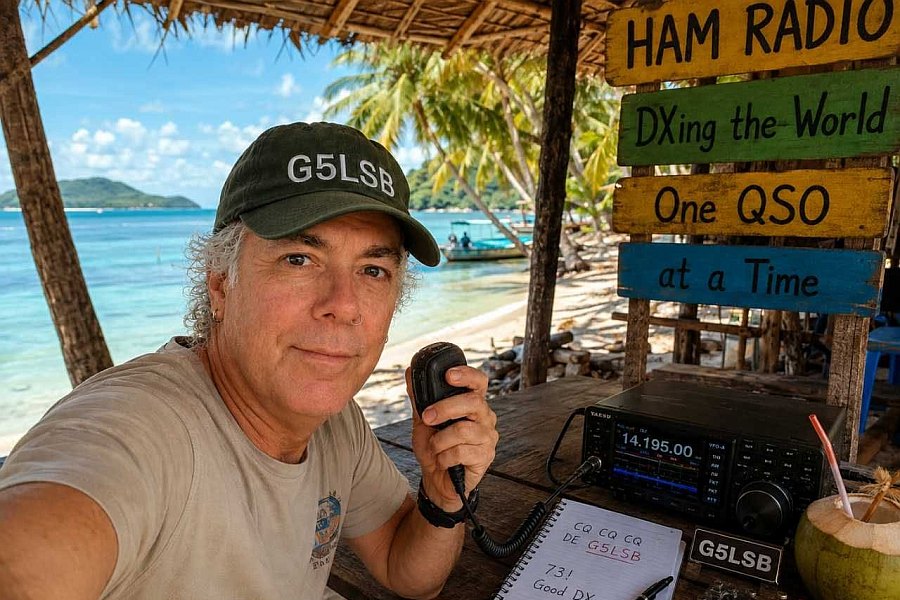
This time, my new licence became available after only four days, and I chose the callsign G5LSB.
Every radio amateur will understand why.
In the next post, I’ll explain the different UK amateur radio licence levels and the privileges that come with each of them.